Influencer products share one common feature. After the launch, once the community that eagerly awaited the product has already made a purchase, it is difficult to create a purchasing need among a new target audience that is completely unfamiliar with the creator.
What have we done?
Testing ad creations with different messaging
Preparing and optimizing the sales funnel
Preparing and optimizing the sales funnel
Challenge
Our challenge was to support the sales of the book’s second edition half a year after its premiere, in order to clear the warehouse before the release of a new title planned for the fall of the following year.
To do this, we primarily had to focus on reaching new users who had not previously been exposed to the client’s work. To achieve this, we started with cold testing, which allowed us to identify prospecting audiences showing the greatest interest in the product.
Parallel to cold targeting, we also conducted research on different sizes and types of groups (depending on the source) as well as lookalike audiences (i.e., people matched by Meta who are similar to a source group – e.g., to those who had previously purchased products in the client’s store).
First months of cooperation
Glass ceiling
After a few months of cooperation, once we could draw conclusions from the data from the conducted advertising campaigns, and following the initial optimizations, we hit a glass ceiling. Regardless of narrowing down and excluding target audiences, the return on ad spend remained at the level of 300-400% in campaigns targeting new audiences.
Is a fourfold return on ads a bad result? Not at all, both the client and we were satisfied with it.
However, it is an open secret that many advertisers rest on their laurels at this stage and merely “maintain” the campaign results, instead of continuing to search for a solution that will help squeeze an even higher return out of them.
We, on the other hand, prefer not to wait for a miracle (or a drop in sustained results due to macro factors) and choose to act instead. That’s why in such situations, we draw conclusions from the data provided by analytics and test possible hypotheses.
How was it this time?
What did we do to boost the already achieved result?
Searching for a solution
From our own experience and after analyzing the advertising campaigns of the companies we consult, we know that with a solid technical setup of ad campaigns, at a certain stage, an increase in effectiveness can only be found in ad creations.
So, we analyzed the messages presented to the audience – both in terms of text and visuals.
In this case, however, the graphic creatives seemed refined in every aspect: the high quality of graphic designs combined with tailoring the messages to the client’s target audience allowed us to reach the best prospects without an increase in ad frequency, while maintaining CTRs.
Despite such personalized creations, the ads we prepared still did not go beyond the achieved several-fold return on ad spend.
Simultaneously, we conducted additional research, which showed a high correlation between regular promotional campaigns for new products in the publishing industry and an increase in ROAS.
However, after discussions with the client, we decided not to introduce regular promotions and sales in her store in the classic sales sense known from big brands’ activities.
We concluded that due to the personal brand established within the community, “transferring” a portion of the hidden costs to the end user could damage the loyalty of regular customers and fans of the profile who bought Moje Dzieci Kreatywnie products first (and at the original price).
Instead of this solution, we decided to introduce an alternative version – free shipping for new customers – essentially combining the research results with the well-known to marketing “power of free”.
Where did the idea for such an alternative come from?
Zero Price Effect
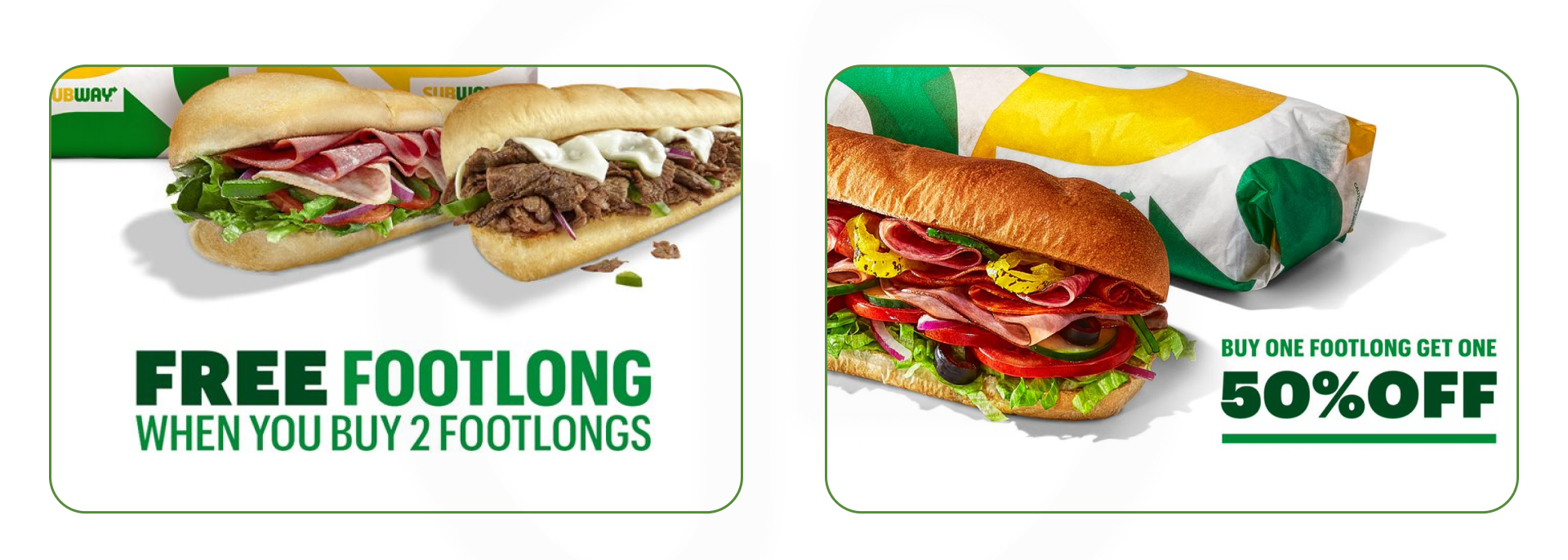
Marketing researchers have long been convinced of the power of “free”. The groups they test always choose the free product, whether it’s the difference in the price of chocolates (Dan Ariely’s experiment with Lindt truffles and Hershey’s), or a second product (instead of a 50% discount on both products, as in the case of Subway marketing tests), or free shipping on Allegro Smart, which we all probably know too well.
Which of the Subway ad creations do you think brought the company a higher return on investment in the promotion?
The conclusions drawn from years of research on freebie marketing are consistent: in the race for the buyer’s interest, regardless of the price, it will always lose out to something that can be offered for free.
This is directly related to the functioning of the human brain, which, seeing the word “free”, starts operating in a “zero price effect” mode, through which it subconsciously analyzing two situations always strongly strives for the one that does not carry any risk (for our brains, “free” = no cost, no loss), and this results in an increased tendency to make irrational decisions.
Following this principle, we decided to slightly modify the content of the ad creatives so that, as part of a promotion dedicated to cold audiences, we offered prospects not only fast and safe, but above all, free shipping.
Verification of assumptions
Testing the solution
It is important not to forget that marketing techniques can yield different results depending on the context, product, target audience, and many additional factors. Theories and techniques proven in certain conditions always require verification within the ultimate target group.
Therefore, we first decided to test the developed promotion to see if, also in the case of Moje Dzieci Kreatywnie, the change in advertising results would be as significant as we initially assumed.
Pay attention
Instead of putting everything on one card based on our story you have just read, which worked in a specific case, remember to conduct tests and adapt your actions to your product and target audience.
Initially, in order not to strain the client’s budget, the tests were conducted only during one week of the analyzed month.
Since the book’s sales page was created by us at the beginning of the collaboration, for the purposes of the tests, we agreed with the client on a schedule of changes to the product page.
Results of the first tests
Initially, in order not to strain the client’s budget, the tests were conducted only during one week of the analyzed month.
Since the book’s sales page was created by us at the beginning of the collaboration, for the purposes of the tests, we agreed with the client on a schedule of changes to the product page.
After conducting a control test in the first week, we planned to introduce free shipping information on the website and launched new ad creations. In the following weeks, we also tested a campaign variant without free shipping information in the ad material, but with free shipping information on the landing page.
The results of the first tests initially confirmed our assumptions – the at first unconvinced cold audience needed an impulse in the form of limited-time free shipping, prompting them to finalize their purchases. However, this impulse had to be addressed already at the stage of the recipient’s contact with the ad.
This was shown by campaign variants where, despite free shipping being active on the product page, and at the same time lacking information about the promotion in the ad material, the audience did not show as much interest in the product as they did with ad creations featuring free shipping prominently.
Verification of the solution
The goal of further testing the initially verified solution was to ensure whether the method would work over a longer period, or if it was merely a coincidence caused by a factor we might not have considered.
So, we planned a separate study, where over the course of two months, we tested identical periods (30 days), alternately turning on and communicating free shipping, and turning off and restoring ad communication without the promotion.
The test results confirmed the expectations we had for the campaign after conducting the weekly test.
Moreover, according to the principle of the Meta advertising algorithm – the longer the campaigns are displayed, the better the algorithm matches the message to the target audience, and the higher ROAS we obtained within the free shipping campaign.
This observation only confirmed that we made the right decision to add the word “free” to our ad messaging. We could successfully adopt such a tested and multi-verified method as effective and permanently introduce it into the client’s advertising activities.
The results of our work
5x
SALES GROWTH
was the result of changing just one word in the ad creation!
1000%
ROAS
we worked out thanks to further campaign optimizations.
3
MONTHS
were taken up by A/B tests that allowed for the analysis of reliable conclusions and a confident implementation of the new strategy.
ROAS = Return On Ad Spend
Currently, we are expanding the scale of advertising activities by promoting the client’s new book based on increased budgeting and new creations related to the title’s premiere.
Additionally, we have initiated activities focused on building a mailing list, through which we are already actively communicating with over 15,000 newsletter readers, via an independent of Social Media sales channel.
Isn't that too much work and time
just to "check one thing"?
Is it worth it?
Work done in such a thoughtful and thorough manner lies at the core of our company values. Commitment to the client’s project as if we were selling our own product, and a partnership approach to the company we work with mean that few advertisers are able to so effectively analyze results, find solutions within them for problems encountered on the advertising path, verify their validity, and implement them.
Our tests showed that implementing the principle of “for free” in the foreground of advertising communication allowed us to “break the ceiling” in the form of a high product price (almost 100 PLN) that was halting the return on investment in advertising aimed at a cold audience above 300-400%.
After final testing and optimization of the developed promotional campaign configuration, we increased the total purchase value from less than 4,000 PLN to almost 20,000 PLN in the first month alone, which resulted in over a 500% increase in revenue generated directly from advertising in the Meta ecosystem. Following optimization, these campaigns bring almost a 1000% return on the budget invested in advertising.
Client's opinion
I have been collaborating with Jakub and his team for over a year now on several levels, and I am very satisfied with the ideas we have implemented, the campaign results, and the timeliness. The landing page, which they also prepared for me for the sale of my book, performed excellently. During our collaboration, Jakub also shares his ideas for improving certain things, and I am slowly already seeing the effects of this. It is definitely worth trusting them, because people with passion, ideas, and extensive knowledge work here.
Ewa Wojtan
Author @ Moje Dzieci Kreatywnie & Dziennik Zabaw
You too can
achieve these results!
By visiting knowledge.moonwise.pl, you can explore our free downloadable materials and find paid online courses on the Meta advertising system at various levels of advancement.
If, on the other hand, you are looking for an agency to manage your advertising campaigns – stop looking and contact us. We will be happy to discuss how we can help you.
A lead generation campaign for the legal industry is quite a challenge. Especially when it’s about sparking the target audience’s interest rather than scaring them. Read how we approached this topic, what changes we made to the customer acquisition journey, and how we achieved such impressive results.
Email marketing is one of the most effective tools for building relationships with customers. However, simply having a newsletter is not enough – the key is effectively acquiring valuable leads at the lowest possible cost. In this case study, we will show how, for a client in the IT and automation industry, we significantly increased the number of newsletter sign-ups while reducing the cost of acquiring them almost sixfold!
During a three-week advertising campaign for one of the leaders in the Data Center industry, we generated over a hundred leads at an exceptionally low price.
For almost two years, we have had the pleasure of working with one of the Polish brands in the home and garden segment. During this time, we have developed a series of marketing activities that have brought impressive results. In this Case Study, you will learn about our shared journey from situation analysis, through testing solutions, to precise scaling of revenue from ads leading to our client’s online store.
Igor Wasiewicz-Pawlaczyk runs Dobre Warsztaty – a company that has been organizing creative workshops, day camps, and summer camps for children and teenagers across Poland for over 6 years.
Despite his extensive experience and generating around a million PLN in annual revenue, Igor struggled with the challenge of effectively scaling his online marketing.
STM Cyber is a dynamically developing company operating in the cybersecurity sector. In August 2024, we began a collaboration aimed at increasing brand visibility in Google search results and acquiring valuable website traffic, which was also intended to help generate high-quality leads that could result in acquiring new customers.
Influencer products share one common feature. After the launch, once the community that eagerly awaited the product has already made a purchase, it is difficult to create a purchasing need among a new target audience that is completely unfamiliar with the creator.
We began our collaboration with a Polish clothing brand in November 2020. As our research showed, the brand was completely unknown at the time, only recognized by enthusiasts as the second RISK made in Warsaw. We decided to gradually change this narrative so that people who get to know the brand and its values would ultimately become its ambassadors and returning customers.
Herbatint, a manufacturer of natural hair dyes and hair care products, is a brand with a mission. The products based on natural ingredients perfectly match the needs of conscious consumers.
The company owner approached us with an ambitious plan related to the development of online sales and advertising effectiveness. Our goal was to create a strategy that would allow us to reach new audiences with a clear sales message and maximize the effectiveness of the advertising budget.
We are here to help you. If you haven’t found the answer to your question on this page, contact us! If you want to work with us, go straight to the point and fill out the marketing brief.